Jan 21, 2026
Digital Transformation Hackathon for a Leading Telecommunications Operator
Training
AI Training
Digital Transformation
Enterprise Innovation
A five-day enterprise hackathon helped telecom teams identify, prototype, and prioritize practical AI and automation use cases.
Overview
A leading telecommunications enterprise wanted to explore how artificial intelligence and automation could be embedded into its operational environment. Leadership recognized the potential of AI, but internal experimentation was fragmented and teams lacked a structured path from ideas to practical implementation.
The organization needed a focused, hands-on engagement that would help teams identify valuable AI opportunities, learn prompt engineering techniques, build rapid prototypes, and evaluate implementation feasibility. The objective was not awareness training; it was practical transformation readiness.
Tech Hosters designed and executed a five-day digital transformation hackathon. The engagement combined operational mapping, AI education, guided ideation, prototype development, validation, and roadmap creation. The result was a structured bridge between enterprise curiosity and actionable AI deployment.
Challenge
The telecom operator needed a structured way to move from AI curiosity to practical, governed experimentation.
The telecom operator faced strategic uncertainty rather than technical incapacity. Teams could see that AI might improve reporting, customer operations, troubleshooting, and internal workflows, but they lacked a disciplined framework for identifying where AI would create measurable value.
Internal experimentation was fragmented, and operational teams were unfamiliar with prompt engineering, automation logic, and governance boundaries. Leadership was also concerned about deploying AI without clear business impact, risk management, or implementation discipline.
The challenge was to create a fast but controlled environment where business teams could test AI use cases safely, understand operational constraints, and produce useful outputs that could support future investment decisions.
Solution
Tech Hosters designed a hands-on transformation sprint combining training, use case development, prototyping, and roadmap planning.
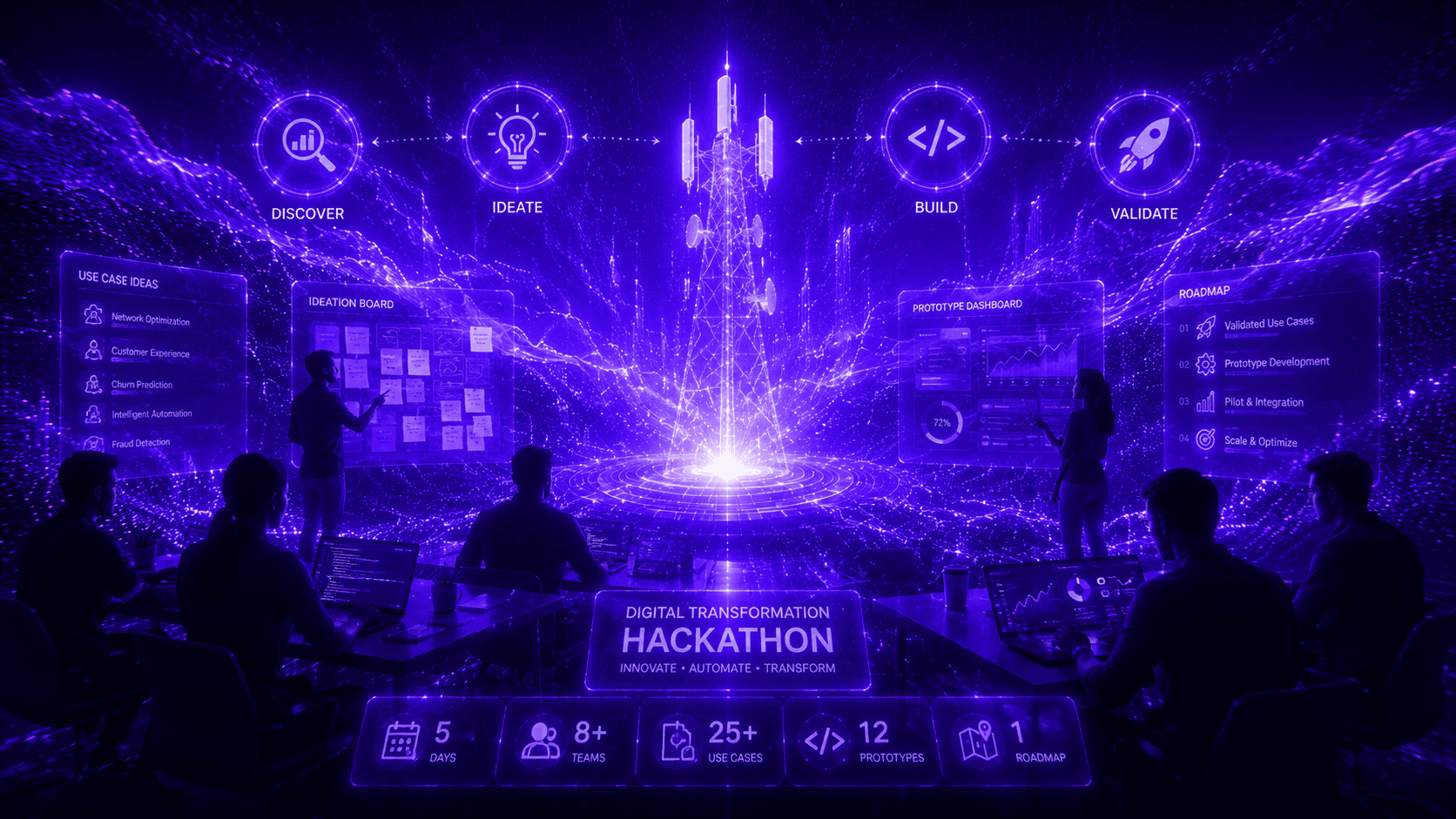
Tech Hosters structured the engagement as a five-day intensive transformation sprint. Each day had a clear purpose and produced practical outputs.
On the first day, teams mapped operational workflows, identified repetitive manual processes, highlighted decision-heavy bottlenecks, and prioritized AI-suitable use cases. Participants were grouped by functional areas such as customer service, network operations, billing, and internal reporting.
On the second day, participants received targeted training on enterprise AI application models, prompt engineering techniques, governance considerations, and workflow design. The training used real company scenarios rather than abstract examples.
On the third day, teams converted operational challenges into AI-driven use case concepts. Ideas included automated internal reporting assistants, intelligent troubleshooting guides, workflow-triggered automation scenarios, and decision-support copilots. Each use case was evaluated against feasibility, ROI potential, and implementation complexity.
On the fourth day, selected concepts were developed into rapid prototypes. Teams built structured prompts, designed automation flows, tested logic sequences, and validated outputs against operational expectations.
On the fifth day, prototypes were evaluated for scalability, documented operationally and technically, assessed for governance fit, and converted into phased roadmap recommendations. Executive presentations summarized business value, cost implications, risks, and next steps.
Day | Focus | Output |
|---|---|---|
1 | Workflow mapping and opportunity identification | Prioritized operational AI opportunities |
2 | AI fundamentals and prompt engineering | Practical team capability development |
3 | Ideation and use case development | Feasible AI concepts and evaluation matrix |
4 | Prototype development and testing | Tested rapid prototypes |
5 | Validation and roadmap creation | Implementation roadmap and executive recommendations |
Results
At the end of the sprint, the telecom operator had multiple validated AI use cases, documented prototypes ready for further production assessment, and a clear prioritization roadmap for automation initiatives. Operational teams also gained practical AI capability through direct experimentation.
Instead of leaving with only theoretical awareness, the organization had tangible models aligned with real operational processes. The hackathon increased internal confidence and gave leadership a clearer basis for deciding which AI initiatives should move forward.
Business Impact
The engagement shifted the organization from exploratory curiosity to structured digital execution. It reduced uncertainty around AI implementation, developed internal capability, and created alignment between AI initiatives and measurable business value.
This case shows how enterprise AI transformation can begin with focused experimentation when the process is structured, governed, and connected to operational realities.
If your organization wants to build practical AI capability through executive workshops, hackathons, and transformation sprints, Tech Hosters can help structure the journey from idea to implementation roadmap. Explore our Training and Digital Transformation services, or contact Tech Hosters to plan your program.