Apr 15, 2026
Generative AI Adoption Benchmark Framework for an Enterprise Organization
Digital Transformation
Generative AI
AI Governance
Enterprise Strategy
A structured benchmark study helped a large organization move from fragmented AI experimentation to governed, measurable adoption planning.
Overview
A large organization wanted to move beyond ad hoc experimentation with Generative AI. Leadership recognized the potential of AI to improve productivity, automate workflows, enhance decision support, and strengthen knowledge management, but the organization lacked a structured adoption model.
The challenge was not simply identifying AI tools. The organization needed to understand where Generative AI could create measurable value, what governance standards were required, which use cases should be prioritized, and how implementation should be phased.
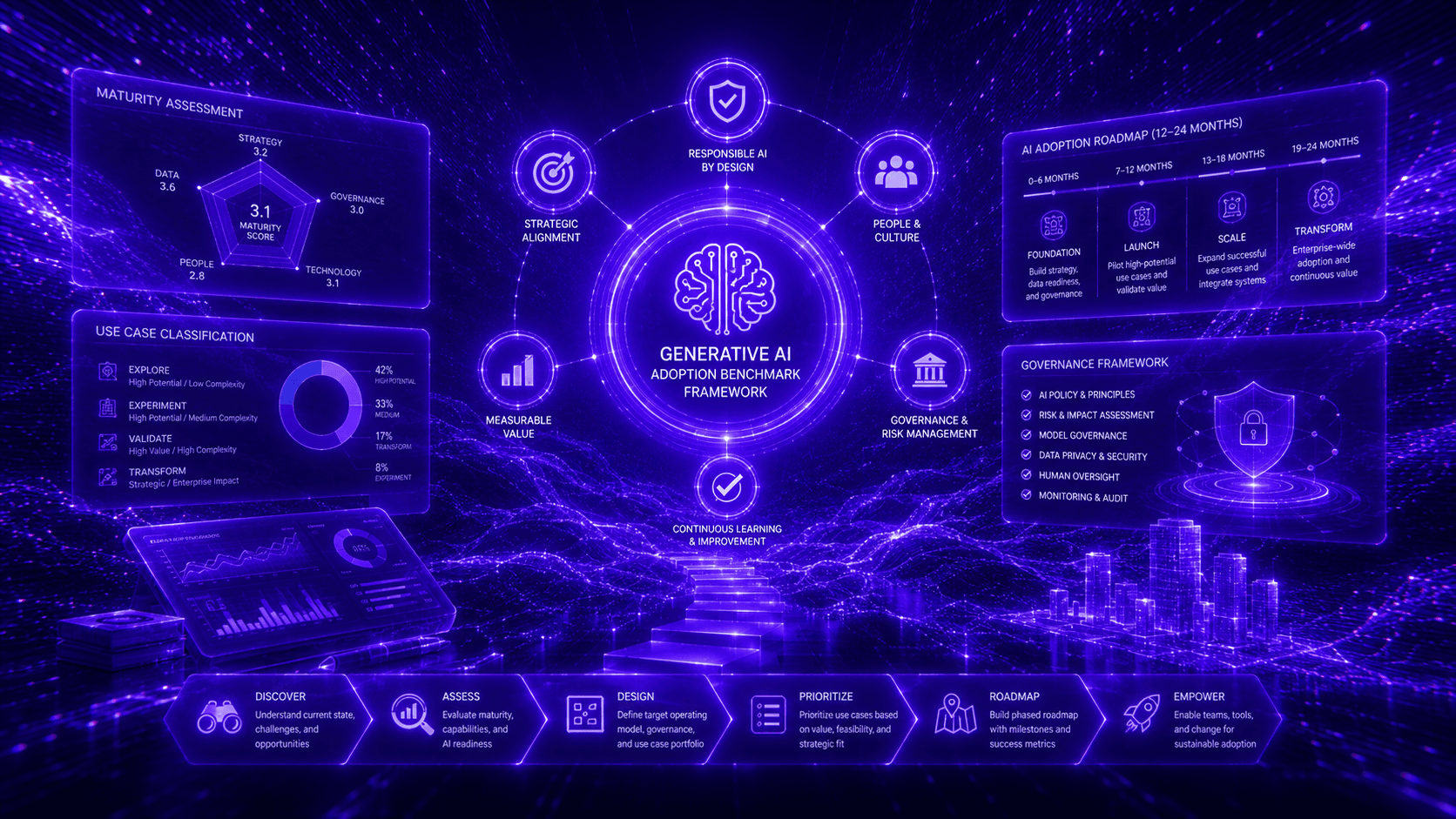
Tech Hosters designed and delivered a comprehensive benchmark study over eight weeks. The engagement translated global best practices and internal readiness analysis into a practical enterprise AI adoption framework. The result was a governed, measurable, and phased approach to Generative AI integration.
Challenge
Leadership needed a practical framework for deciding where Generative AI could create value without increasing governance and compliance risk.
The organization faced strategic ambiguity. Different teams were experimenting with AI in disconnected ways, but there was no shared framework for evaluating value, feasibility, risk, data sensitivity, or implementation complexity.
This created several concerns. Leadership did not have clear visibility into where AI could produce measurable business value. Governance structures were not yet formalized. Data security and compliance risks needed to be addressed before wider deployment. There was also no standardized model for comparing AI opportunities across departments.
The organization required a structured reference model tailored to its operating environment. The model needed to help leadership make investment decisions, reduce experimentation risk, and guide AI implementation over a realistic planning horizon.
Solution
Tech Hosters developed a benchmark-based AI adoption model covering maturity, governance, use cases, roadmap, and value measurement.
Tech Hosters structured the engagement across four analytical layers.
The first layer was global benchmark research. We reviewed enterprise AI adoption models, governance frameworks, risk management standards, operating models, and cross-industry implementation patterns. The goal was not to copy isolated examples, but to identify repeatable principles that could be adapted to the client’s environment.
The second layer was internal capability assessment. We evaluated digital maturity, data infrastructure readiness, process standardization, compliance requirements, workforce skill gaps, and the existing automation footprint. This created a practical maturity baseline and helped determine which AI opportunities were realistic in the near term.
The third layer was use case classification. A structured AI opportunity matrix was developed to categorize potential applications into productivity augmentation, workflow automation, decision support, customer interaction enhancement, content generation, documentation, and internal knowledge management. Each use case was scored by feasibility, risk exposure, data sensitivity, expected ROI, and implementation complexity.
The fourth layer was governance and operating model design. Tech Hosters established a framework covering data access boundaries, model usage policies, prompt engineering standards, output validation requirements, human oversight layers, and risk controls. An AI Center of Excellence model was also defined to manage longer-term deployment.
Deliverable | Purpose |
|---|---|
Enterprise AI Maturity Assessment | Establish the organization’s readiness baseline |
Generative AI Best Practice Compendium | Provide reference patterns for adoption |
Risk and Governance Framework | Define responsible AI usage boundaries |
Prioritized AI Use Case Roadmap | Sequence implementation over 12–24 months |
Capability Development Plan | Identify training and skill-building needs |
KPI and ROI Measurement Model | Track value creation and investment impact |
Results
The organization gained clear strategic direction for Generative AI deployment. Fragmented experimentation was replaced with a structured governance model, a prioritized roadmap, and a shared framework for evaluating opportunities.
Leadership gained clearer visibility into which AI initiatives should move forward, what risks needed mitigation, and how success should be measured. Internal alignment improved because AI adoption became connected to business value, governance controls, and phased implementation planning.
Business Impact
The benchmark study enabled the organization to transition from uncertainty to structured execution. Instead of reactive experimentation, the organization gained defined governance standards, measurable AI value metrics, implementation phases, and risk-aware deployment controls.
This case demonstrates the importance of strategy before scale. For enterprises adopting Generative AI, sustainable value depends on governance, operating model design, maturity assessment, and a disciplined use case roadmap.
If your organization is exploring Generative AI but needs governance, prioritization, and a measurable adoption roadmap, Tech Hosters can help build the strategy before implementation. Explore our Digital Transformation and AI & Automation services, or contact Tech Hosters to discuss an AI adoption framework.