Nov 21, 2025
Data Analytics for SMEs: Turning Business Data into Better Decisions
Data Analytics
Business Intelligence
SME Growth
Data analytics helps SMEs move from intuition and delayed reporting to faster, clearer, and more confident business decisions
Every growing business produces data. Sales conversations, invoices, website visits, marketing campaigns, support requests, inventory records, project timelines, and customer feedback all contain signals about how the company is performing. Yet many small and medium-sized enterprises still make important decisions using incomplete reports, manual spreadsheets, or intuition alone.
This does not mean intuition has no value. Experienced leaders often understand their customers and markets deeply. The problem is that intuition becomes less reliable as the business grows. More customers, more channels, more employees, and more systems create more complexity. Data analytics helps leaders manage that complexity with clearer evidence.
The OECD has examined the role of data analytics in SMEs and its potential to support SME performance and data-driven decision-making.1 For practical business purposes, the message is clear: SMEs do not need to become technology companies to benefit from analytics. They need to use their existing data more intelligently.
What Data Analytics Means for SMEs
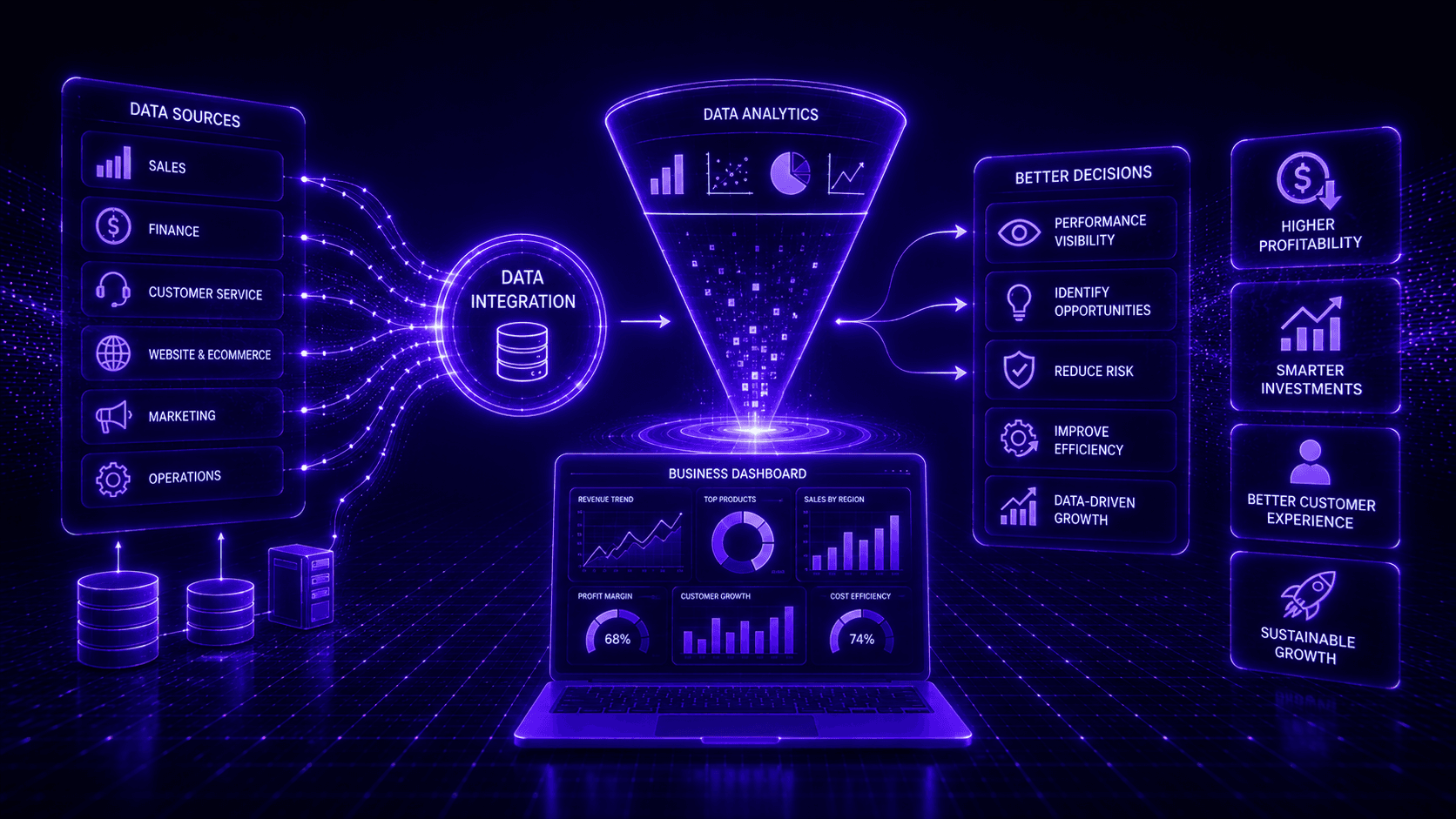
Data analytics is the process of collecting, organizing, analyzing, and interpreting data to support better decisions. For SMEs, this usually begins with business intelligence dashboards, performance reports, customer segmentation, sales analysis, financial visibility, and operational metrics.
The goal is not to collect as much data as possible. The goal is to answer better business questions. Which customers are most profitable? Which services are growing fastest? Which marketing channels produce quality leads? Where are projects delayed? Which support issues repeat most often? Which costs are rising faster than revenue?
Business Question | Data Needed | Decision Supported |
|---|---|---|
Which services generate the best margin? | Revenue, cost, delivery time, project effort | Pricing and service strategy |
Which marketing channels produce qualified leads? | Website analytics, campaign data, CRM data | Marketing budget allocation |
Which customers are at risk of leaving? | Support tickets, usage, payment history, engagement | Retention planning |
Where are operations slowing down? | Workflow timestamps, task status, approvals | Process improvement |
Which products or services should we promote? | Sales trends, margin, customer demand | Growth planning |
Analytics becomes valuable when it connects data to decisions.
Why SMEs Often Struggle with Data
Most SMEs do not suffer from a lack of data. They suffer from disconnected data. Customer information may live in email inboxes, spreadsheets, accounting software, CRM systems, website forms, and project tools. Each system may be useful, but the business lacks a single view of performance.
Another challenge is inconsistent definitions. One team may define a lead differently from another. Finance may report revenue by invoice date, while sales reports revenue by deal close date. Operations may track project completion differently across teams. These differences create confusion and reduce trust in reports.
A third challenge is manual reporting. Many SMEs depend on employees to export spreadsheets, clean data, combine files, and prepare recurring reports. This takes time and increases the risk of errors. When reports are delayed, leaders are forced to make decisions based on yesterday’s information.
Data Problem | Business Impact | Better Approach |
|---|---|---|
Data scattered across tools | No complete view of performance | Integrate key systems and define reporting priorities. |
Manual spreadsheets | Slow reporting and higher error risk | Automate recurring reports and dashboards. |
Inconsistent definitions | Teams debate numbers instead of decisions | Create shared KPI definitions. |
Poor data quality | Low trust in insights | Assign ownership and clean core records. |
No link to decisions | Reports are viewed but not used | Build dashboards around management questions. |
The Most Useful Analytics Areas for SMEs
SMEs should begin with analytics areas that directly support management decisions. The best starting point is usually a small set of dashboards that give leadership visibility into revenue, customers, operations, marketing, and cash flow.
Sales analytics helps companies understand pipeline quality, conversion rates, deal size, sales cycle length, and customer segments. This allows leaders to see whether growth depends on a few large deals, whether follow-up is slow, or whether certain services sell better in specific markets.
Marketing analytics helps connect campaigns to actual business outcomes. Website traffic alone is not enough. SMEs should understand which channels generate qualified leads, which content attracts decision-makers, and which campaigns produce sales conversations.
Operational analytics helps identify bottlenecks. If projects are delayed, tickets are unresolved, or approvals are slow, analytics can show where time is lost. This is especially important for consulting, IT services, hosting, and support-based businesses.
Financial analytics helps leaders understand margin, cash flow, recurring revenue, cost trends, and profitability by service line. Without this visibility, companies may grow revenue while quietly weakening profitability.
From Reporting to Decision Intelligence
Basic reporting describes what happened. Good analytics explains why it happened. Advanced analytics helps predict what may happen next. SMEs should not try to jump immediately to advanced AI forecasting if basic data is not yet reliable. Instead, they should build analytics maturity step by step.
Maturity Stage | Description | Example |
|---|---|---|
Descriptive reporting | Shows what happened | Monthly revenue dashboard |
Diagnostic analytics | Explains why it happened | Lead conversion dropped because response time increased |
Predictive analytics | Estimates what may happen next | Forecasting sales pipeline or customer churn |
Prescriptive analytics | Recommends what to do | Suggesting the next best action for a customer segment |
This progression is important because AI depends on data maturity. A business that cannot trust its reports will struggle to trust AI recommendations. Reliable analytics is therefore not separate from AI strategy. It is the foundation for it.
How SMEs Can Start with Data Analytics
The best first step is to identify the decisions that matter most. Instead of asking, “What dashboard should we build?” leaders should ask, “Which decisions are currently too slow, unclear, or risky?”
Once those decisions are identified, the company can define the key metrics, locate the required data, clean the most important records, and build a dashboard or reporting process around leadership needs.
Step | Practical Action | Output |
|---|---|---|
1. Define decision priorities | Identify the top 5–10 recurring management decisions | Analytics focus areas |
2. Select KPIs | Choose metrics that support those decisions | KPI dictionary |
3. Map data sources | Identify where the required data lives | Data source inventory |
4. Improve quality | Clean duplicates and standardize definitions | Trusted core data |
5. Build dashboards | Create visual reports for leadership and teams | Business intelligence dashboard |
6. Review regularly | Use analytics in management meetings | Decision rhythm |
The most successful analytics systems are not the most complex. They are the systems that leaders actually use.
Data Analytics and Customer Experience
For SMEs, one of the most valuable uses of analytics is improving customer experience. Data can show which customers are most engaged, which service issues repeat, which response times are too slow, and which customer segments need more attention.
This matters because customer experience is often where SMEs compete against larger companies. A smaller business may not have the largest budget, but it can be faster, more personal, and more responsive. Analytics helps make that responsiveness systematic rather than accidental.
For example, a company can use customer support data to identify recurring problems and improve documentation. It can use website behavior to understand which services visitors are most interested in. It can use CRM data to follow up with leads more consistently. It can use invoice and service data to identify which customers may need renewal support or additional services.
Conclusion
Data analytics helps SMEs move from reactive management to informed decision-making. It gives leaders clearer visibility into sales, operations, customers, finance, and marketing. It also creates the foundation for future AI and automation initiatives.
The key is to keep analytics practical. Start with business questions, define the right KPIs, connect the most important data sources, and build reports that support real decisions. Over time, analytics can become a strategic capability that improves speed, confidence, and competitiveness.
Tech Hosters helps companies turn fragmented business data into practical dashboards, reporting systems, and analytics foundations for digital transformation. Explore our Data Analytics, Digital Transformation, and AI & Automation services, or contact Tech Hosters to discuss your data strategy.