Feb 6, 2026
How AI Automation Reduces Operational Costs for SMEs
AI & Automation
AI Automation
Business Process Automation
Operational Efficiency
A practical guide to using AI automation to reduce repetitive work, improve decision speed, and protect service quality as your business grows.
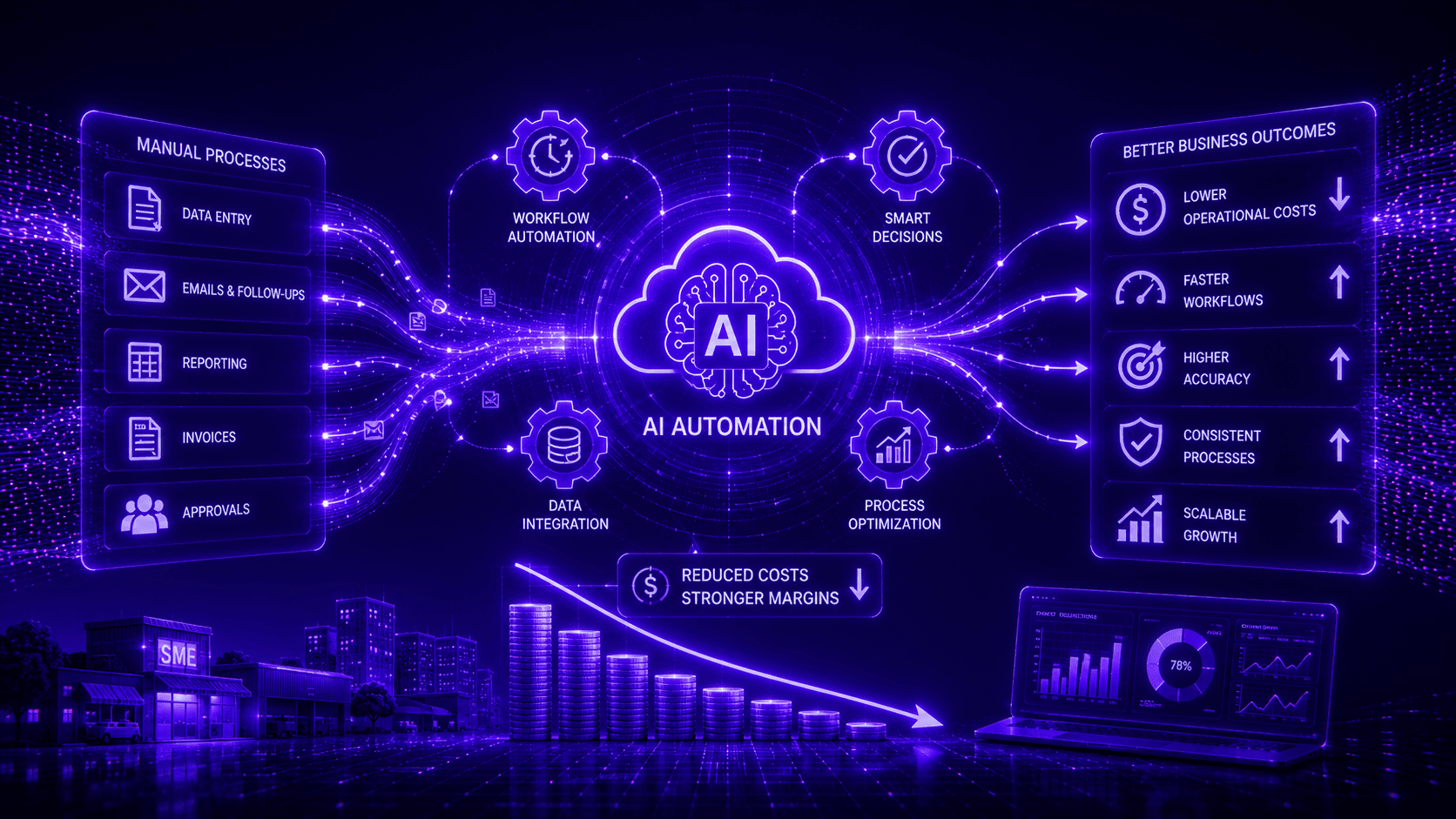
For many small and medium-sized enterprises, operational cost is not only a finance issue. It is a growth issue. When teams spend too much time on repetitive administration, manual reporting, customer follow-up, invoice processing, internal approvals, or data entry, the company becomes slower and more expensive to operate.
AI automation gives SMEs a practical way to reduce this pressure. It can help companies handle routine tasks faster, reduce human error, route information to the right people, and give managers better visibility into operations. Deloitte’s enterprise AI research identifies productivity, efficiency, decision-making, cost reduction, and customer relationship improvement as major areas where organizations are applying AI.1
However, AI automation should not be treated as a shortcut or a collection of disconnected tools. The best results come when automation is designed around a clear process, a measurable business outcome, and a realistic understanding of how people work.
What AI Automation Means for SMEs
AI automation combines traditional workflow automation with artificial intelligence capabilities such as classification, prediction, language understanding, summarization, recommendation, and intelligent routing. Traditional automation follows fixed rules. AI automation can handle more variation because it can interpret documents, messages, customer requests, patterns, and historical data.
This distinction is important for SMEs because many business processes are not perfectly structured. Customer emails arrive in different formats. Invoices come from different suppliers. Employees write notes differently. Sales leads have different levels of urgency. AI can help interpret this unstructured information and trigger the next action.
Business Area | Traditional Automation | AI Automation |
|---|---|---|
Customer support | Sends an automatic confirmation email | Classifies the request, suggests a reply, and routes it to the right team |
Finance | Sends recurring invoice reminders | Extracts invoice data, flags anomalies, and prioritizes approvals |
Sales | Adds form submissions to a CRM | Scores lead quality and recommends follow-up actions |
Operations | Sends task notifications | Predicts delays and highlights workflow bottlenecks |
Reporting | Generates scheduled reports | Summarizes trends and explains performance changes |
The value is not only speed. The deeper value is that AI automation can make a smaller team operate with more consistency and better visibility.
Where SMEs Should Start
The best starting point is not the most advanced AI use case. It is the process where manual effort, repetition, and business impact overlap. A good automation candidate usually has four characteristics: it happens often, it follows a recognizable pattern, it consumes employee time, and it creates measurable cost or service impact when delayed.
SMEs should begin by mapping operational friction. This means identifying where employees repeatedly copy data between systems, answer similar questions, wait for approvals, search for documents, create recurring reports, or manually check information that could be validated automatically.
Process Type | Automation Potential | Why It Matters |
|---|---|---|
Invoice and document processing | High | Reduces manual entry, delays, and approval errors. |
Customer support triage | High | Improves response time and service consistency. |
Sales lead qualification | Medium to high | Helps sales teams focus on better opportunities. |
Internal reporting | High | Saves management time and improves visibility. |
HR onboarding tasks | Medium | Creates consistent employee experience. |
IT support requests | High | Reduces repetitive support workload. |
A practical first automation project should be small enough to implement quickly but important enough to prove business value.
How AI Automation Reduces Cost
AI automation reduces operational cost in several ways. The first is direct time saving. If employees spend hours each week on repetitive tasks, automation can return that time to higher-value work such as customer service, sales, analysis, and problem solving.
The second is error reduction. Manual processes often create hidden costs through duplicated work, incorrect data, missed follow-ups, and delayed approvals. AI automation can standardize inputs, validate information, and flag exceptions before they become expensive problems.
The third is faster decision-making. When managers receive better summaries, alerts, and predictive signals, they can act earlier. This is especially valuable for SMEs where leadership teams often manage multiple functions at once.
The fourth is scalability. A company that automates routine workflows can often grow without increasing administrative headcount at the same rate. This does not mean replacing people. It means allowing employees to spend more time on work that requires judgment, relationship-building, creativity, and strategic thinking.
Practical principle: AI automation should not remove accountability. It should remove unnecessary friction so people can make better decisions faster.
Avoiding Automation Mistakes
Many automation projects fail because companies automate a weak process without improving it. If a workflow is unclear, inconsistent, or poorly owned, automation may make the problem faster rather than better. Before implementing AI automation, SMEs should simplify the workflow, define ownership, and decide which decisions should remain human-controlled.
Another common mistake is using too many disconnected tools. An SME may adopt one AI tool for customer service, another for reporting, another for documents, and another for marketing. Without integration, this creates a fragmented operating model and increases complexity.
Data quality is also essential. AI automation depends on reliable information. If customer records, product data, financial records, or internal documents are inconsistent, automation will be limited. Deloitte’s enterprise AI research highlights data, governance, workforce readiness, and workflow redesign as important factors in scaling AI effectively.1
Mistake | Business Risk | Better Approach |
|---|---|---|
Automating before process review | Faster confusion | Map and simplify the workflow first. |
Choosing tools before goals | Low ROI | Start with cost, time, quality, or customer metrics. |
Ignoring employee adoption | Workarounds and resistance | Train users and involve them early. |
Poor data quality | Inaccurate outputs | Clean core data and define ownership. |
No governance | Compliance and trust issues | Decide approval rules, human review points, and audit trails. |
A Practical AI Automation Roadmap
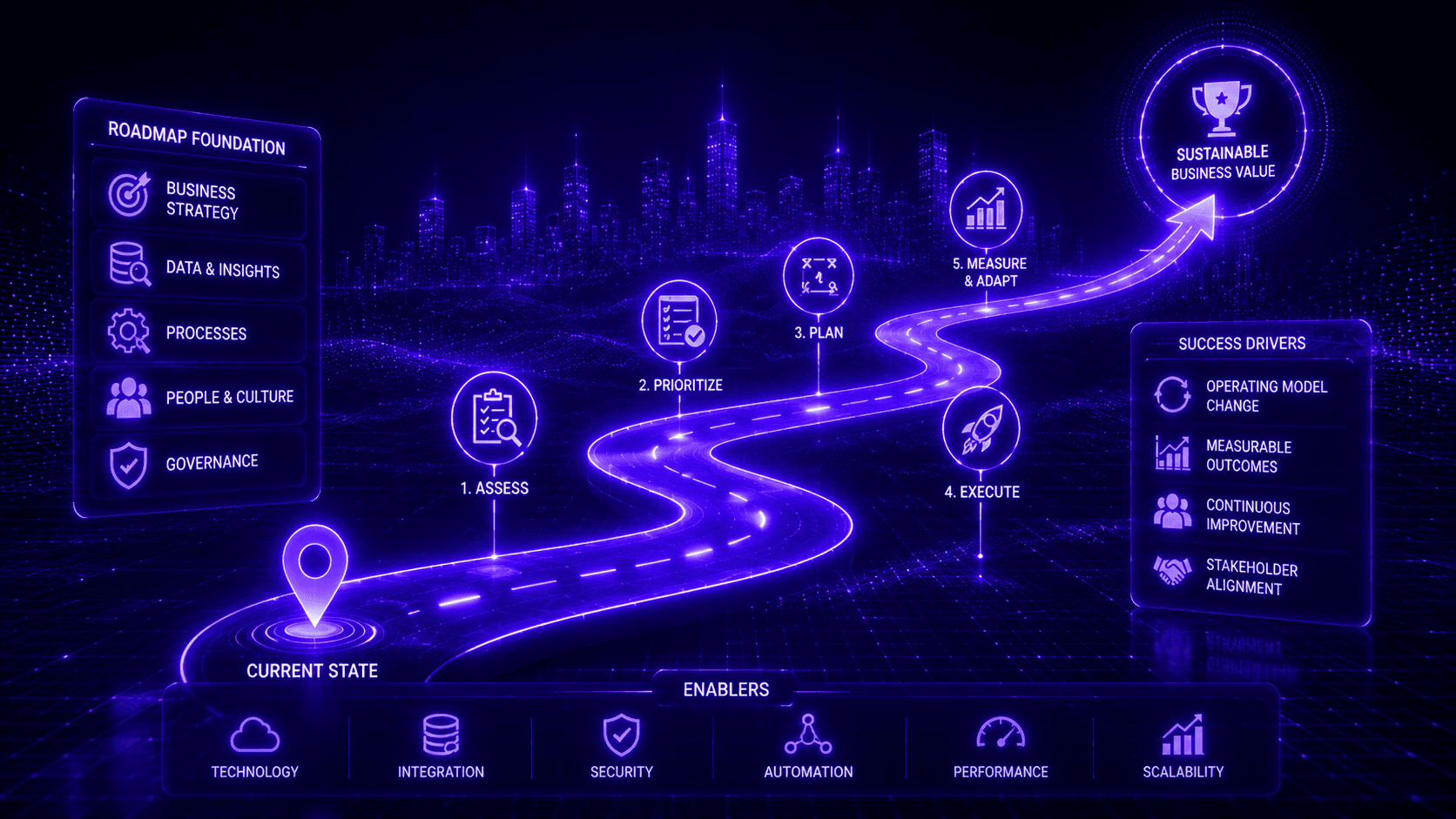
A good roadmap does not need to be complicated. SMEs can begin with a structured approach that moves from diagnosis to implementation.
Stage | Main Question | Output |
|---|---|---|
1. Process discovery | Where is time being lost? | List of automation opportunities |
2. Prioritization | Which process has the best value-to-effort ratio? | First automation use case |
3. Workflow design | What should the future process look like? | Automation workflow map |
4. Data and tool selection | What information and systems are required? | Technology and integration plan |
5. Pilot | Does the automation work in real conditions? | Tested workflow and feedback |
6. Scale | How do we expand without losing control? | Governance and rollout plan |
This approach helps SMEs avoid expensive experimentation and focus on measurable outcomes.
Conclusion
AI automation is one of the most practical ways for SMEs to reduce operational costs and improve service quality. The strongest results come from automating the right processes, not from adopting the newest tool. A successful automation program begins with business pain points, connects to measurable outcomes, and includes people, data, governance, and integration from the start.
For growing companies, the goal is not to automate everything. The goal is to automate the work that slows the business down, so people can focus on the work that moves the business forward.
Tech Hosters helps companies identify automation opportunities, design practical workflows, and implement AI solutions that support real business outcomes. Explore our AI & Automation, Digital Transformation, and IT Support services, or contact us to discuss your automation roadmap.